Future of geo location including ads, #Foursquare for doing good and more.

Geolocation (geography and location) is being re-defined in the social media space by a few key players, one in particular that I use is Foursquarehttp://gowalla.com/  and   http://www.rummble.com/  also avail, but have not used them (yet)

I have been using Foursquare for a while, and have found it to be fun, an element of my social media footprint, outreach to my fellow sm friends and a while back, I even heard I may get a free beer if I checked into a corner bar near my office. Oh I’m sorry, not sure what I’m talking about… don’t yet use it…?  What is Foursquare? 
Real quick:

You need the app on your phone (and/or mobile device)
Then when you’re out and about – you “check in” to places with the click or touch of your finger.
Share these “check-ins” with your friends, followers, fans, where you may get a “tip” from a fellow foursquare member of what to do at the particular location.
You can also earn points, and unlock badges. This I get, but am not personally into. (I guess because I am not 14 and wanting to earn virtual/digital graphic representations of a badge.) But some do, and thats cool with me.)

Now listen to this – if you check in to a location more than others, you become the “mayor” of that location. And this is where it gets interesting. Check into a restaurant more than others, and you may get a free meal out of it. Ahhh HA!!! Potential here – right!?

In fact here is a list of “freebies” http://foursquare.com/businesses/

Still confused? Not to worry. Here is the scoop- straight from their site.
We’re all about helping you find new ways to explore the city., We’ll help you meet up with your friends and let you earn points and unlock badges for discovering new places,  doing new things and meeting new people. [Learn more!], If you own a bar or restaurant,  foursquare can help you find new ways to connect with your customers. If you’re a developer,  check out the foursquare API.

The HELP section goes into details. http://foursquare.com/help/

Those of you who use Foursquare, know what I’m talking about, those who don’t – you should try it out… and find me on Foursquare.

http://foursquare.com/user/johnayers

Hey another thing, I was actually at a meeting last week at Los Angeles City Hall, and decided to “check in”. As I was doing so, I thought I would see who the virtual/Foursquare “mayor” was… it Was NOT LA’s Mayor Villaraigosa.

This interested me too.

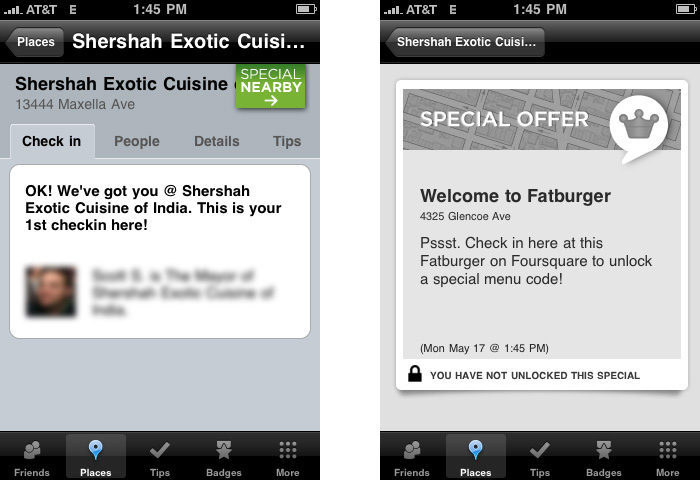
I was at a local restaurant today having lunch. I decided to “check in” and then a little green prompt (advertisement) came up on the screen. (see image) 
But NOT for the restaurant I was at, but rather a burger joint just around the corner from where I was. Now this is very interesting from a marketing standpoint. Own a business in a mall with 350 stores. Anyone who checks into ANY of the other stores, and you can run an ad on Foursquare… hmmm…

This is an article from a few months ago you may find of interest.  http://tinyurl.com/ygxgs2z
Future of Foursquare: http://tinyurl.com/29e9c6k   and   http://tinyurl.com/y8bn7zn  and http://tinyurl.com/ykakhey

Foursquare_ads

NOTE:
Foursquare, Inc. folks; please keep me updated on future news and plans. Would love to know your next steps into monetizing, incentivizing and utilizing your geo-location tool(s).
Finally, and maybe most importantly, when you/we come up with a plan to use geo-location “for doing good” – we may really “have” something.
John

No more Facebook. Why some major Tech Gurus are deleting their Facebook account.

Yes, Leo Laporte the Tech Guy (as he is known) has left Facebook. He has signed off. Deleted his account. Primarily because of the same reason I and others have become ever more concerned… The issue is PRIVACY.

With over 50 settings, over 170 options,AND Facebook constantly changing their policy… nobody, I mean even Matt Zuckerberg really knows what their privacy settings are… and THAT is the issue.

This is not by accident, and it is not to help the individual, it is to confuse us, the user. It is exactly the opposite of what SOCIAL media is really about. Remember Web 2.0. – two way communication, Web 3.0, social communication…
Nofacebook
In 2005, FACBOOK’s privacy policy was 1004 words. Today, 2010 it is over 5800 words (longer than the US Constitution). These aren’t my numbers, I found these in a recent article.

Here is the fact. If you are ON Facebook, and you post something/anything – just be rest-assured that your information is PUBLIC.
There were some great info-graphics in the NY Times that you must check out.

Truth be told, I use Facebook, try to keep up with the settings, enjoy the connections, navigate it for work, friends and family… but I and others are watching VERY closely, as we all together are going through the social media experiment.

For now, I will stay on Facebook, and keep my eyes and ears wide open.
OK, if you’re interested… you can find me at Facebook here:
facebook.com/ayers
twitter.com/johnayers
johnlayers.wordpress.com
linkedin.com/in/johnlayers
johnayers.posterous.com

If you want to read more on the Facebook Privacy issue there is a great number of blogs, articles and stories, here are a few:

http://www.insidefacebook.com/2010/05/11/analysis-some-facebook-privacy-issues-are-real-some-are-not/http://www.eweek.com/c/a/Security/Facebook-Faces-Privacy-Concerns-Despite-Tightened-Security-569083/
http://www.cnn.com/2010/TECH/05/14/facebook.security.privacy/

http://techcrunch.com/2010/05/13/the-media-attacks-on-facebook-and-mark-zuckerberg-are-getting-out-of-hand/

http://www.readwriteweb.com/archives/why_facebook_is_wrong_about_privacy.php

http://www.mirror.co.uk/news/top-stories/2010/05/15/facebook-crisis-talks-after-anger-over-privacy-changes-115875-22259922/

http://www.telegraph.co.uk/technology/facebook/7723320/EU-criticises-Facebook-privacy-changes.html

Gif1

No more Facebook. Why some major Tech Gurus are deleting their Facebook account.

Yes, Leo Laporte the Tech Guy (as he is known) has left Facebook. He has signed off. Deleted his account. Primarily because of the same reason I and others have become ever more concerned… The issue is PRIVACY.

With over 50 settings, over 170 options,AND Facebook constantly changing their policy… nobody, I mean even Matt Zuckerberg really knows what their privacy settings are… and THAT is the issue.

This is not by accident, and it is not to help the individual, it is to confuse us, the user. It is exactly the opposite of what SOCIAL media is really about. Remember Web 2.0. – two way communication, Web 3.0, social communication…
Nofacebook
In 2005, FACBOOK’s privacy policy was 1004 words. Today, 2010 it is over 5800 words (longer than the US Constitution). These aren’t my numbers, I found these in a recent article.

Here is the fact. If you are ON Facebook, and you post something/anything – just be rest-assured that your information is PUBLIC.
There were some great info-graphics in the NY Times that you must check out.

Truth be told, I use Facebook, try to keep up with the settings, enjoy the connections, navigate it for work, friends and family… but I and others are watching VERY closely, as we all together are going through the social media experiment.

For now, I will stay on Facebook, and keep my eyes and ears wide open.
OK, if you’re interested… you can find me at Facebook here:
facebook.com/ayers
twitter.com/johnayers
johnlayers.wordpress.com
linkedin.com/in/johnlayers
johnayers.posterous.com

If you want to read more on the Facebook Privacy issue there is a great number of blogs, articles and stories, here are a few:

http://www.insidefacebook.com/2010/05/11/analysis-some-facebook-privacy-issues-are-real-some-are-not/http://www.eweek.com/c/a/Security/Facebook-Faces-Privacy-Concerns-Despite-Tightened-Security-569083/
http://www.cnn.com/2010/TECH/05/14/facebook.security.privacy/

http://techcrunch.com/2010/05/13/the-media-attacks-on-facebook-and-mark-zuckerberg-are-getting-out-of-hand/

http://www.readwriteweb.com/archives/why_facebook_is_wrong_about_privacy.php

http://www.mirror.co.uk/news/top-stories/2010/05/15/facebook-crisis-talks-after-anger-over-privacy-changes-115875-22259922/

http://www.telegraph.co.uk/technology/facebook/7723320/EU-criticises-Facebook-privacy-changes.html

Gif1

Social Media’s Future and a few important articles you may have missed. Read them now.

Social Media”Life moves pretty fast. If you don’t stop and look around once in a while, you could miss it.” Ferris Bueller

I decided to take a moment and pause to look at life…  A look at Digital life actually.  Social Media… Digital media… and as Ferris says

… If you don’t stop and look around once in a while, you could miss it . Maybe that’s just what we’re doing. Missing it.

Is it possible that there are more people sending social media messages than receiving them? Can it be that the number of new applications being engineered far outweigh the number of users? Is this THE time where Andy Warhol’s famed quote (“In the future, everyone will be world-famous for 15 minutes.”) is happening? The fact is,  at the moment – maybe so. This is why there are still business models being formed after a company is valued in the billions of dollars. This is the wild-west in the digital age.  User generated content is sliding into consumer generated content… and THAT is a shift.

Record companies have gone to the mp3 files uploaded by the unkown (but amazing) garage band. Newspapers are dropping like flies – as expert bloggers gain massive readers. Traditional TV models are changing daily and there is big money involved. How to keep up and what to do? Hold on tight and stay current, well as much as you can.

I decided to share a few articles on where the landscape is in terms of marketing and advertising in these fast growing, and ever changing environments.  Some great articles out there to dive into, and these are a few of them.

I start with TV… because it is happening right now, and I work on TV branding campaigns quite often. The model may be a bit different but yet it is still the same.

Here’s a great post about Twitter’s move into advertising:

Story here about Facebook’s ads

Some social media trends to look for this year.
and how it will change in 2010

A list of Top Social Networking Websites

An overview of some sm resources you may have missed.

…and if you don’t know about chris brogran’s posts – you should

Good Luck all,
John

Also, If you have a minute, please check out our running at winning a Pepsi Refresh Grant.
learn about

vote here

In the running for a $250,000 Pepsi Refresh Everything Grant to offer FREE Broadband Wi_Fi.

Free_broadband_sqlogo

Just learned today that we have been accepted and are now in the running for a $250,000 Pepsi Refresh Everything Grant to offer FREE Broadband Wi_Fi.

Please vote TODAY and EVERYDAY… and share this with your friends, fans, followers, colleagues, and neighbors.

to learn more
http://openneighborhoods.net/freebroadband.htm

to vote
http://www.refresheverything.com/freebroadband

Remember you can vote everyday until May 31st! The idea with the most votes wins. So Spread the word!
Thanks,
John

Currently Reading Advertising Age article on “Why Promoted Tweets Will Change the Game for Advertisers”

Just read this article in AdAge about Twitter’s move into Advertising. It’s PROMOTED TWEETS – or PT if you’re in the know. A must read for advertisers, social media mavens, media people, brand developers. MySpace, Facebook, YouTube, StumbleUpon and others have all stepped into advertising models, now Twitter joins ’em. Be aware of bloggers with large readers… Social Media Advertising is here and a major force in consumer’s behavior.

Why Promoted Tweets Will Change the Game for Advertisers

Twitter’s Ad Platform Forces Agencies to Ditch Old Methods, Focus on Ideas

Posted by B.L. Ochman on 04.22.10 @ 09:33 AM

B.L. Ochman

Promoted tweets, Twitter’s long-awaited new ad platform, will be a certain game-changer for the advertising industry (and everyone else). The sea change is that ad agencies will have to give up their century-old practice of getting paid for media buys and giving the creative away for nothing. From now on, ideas rule.

Until now, Madison Avenue has either ignored or bumbled such remarkable online ad opportunities as advertising on blogs and social bookmarking sites. That’s because the budgets are too small to support ad agencies’ bloated financial model.

Advertising on blogs and in other emerging media outlets has always needed to resonate to be effective, and traditional agencies have failed to adapt to the differences between new media ads and the tired interruption model of old media.

Agencies easily make $250-500K (and often much more!) to produce and buy a 30-second TV spot. A company can make a significant brand splash for a week, with advertising on a dozen or more relevant blogs with $25 or 50K.

While a print ad can easily cost $250K+ for photography, design, photography, models and production, it’s rare to see that size budget for a StumbleUpon campaign or for content sponsorship in a social network.

Madison Avenue has not wanted to be bothered with the (relatively) small budgets involved in even the biggest blog and social media ad campaigns.

So the push/interuption/how-obnoxious-do-we-have-to-be-before-you-look-at-these-damn-banner-ads school of advertising keeps feeding on itself in the endless quest for more money.

But relevancy will now rule on Twitter’s promoted tweets, and other online advertising is sure to follow. Because, if people don’t find promoted tweets interesting enough to interact with and share, the ads will be banished.

Promoted tweets will use a “Resonance Model,” which will combine earned and paid media. There will be, he said, a multiple axis of engagement that measures not just click-throughs, but also replies, favoriting, link clicks, the influence of the people who re-tweet, the use of a hashtag in conversations about the PT. There will be a total of nine resonance factors in all.

When promoted tweets don’t resonate, they will simply disappear. Twitter’s Chief Operating Officer Dick Costolo explained at last week’s AdAge’s Digital Conference and again at Twitter’s first developer’s conference, Chirp, that Twitter will continue to be to many real-time transparent communication that represents the interests of users. If the ads don’t resonate, they will not continue to run.

There will be no way to make them bigger, to add more flashturbation, to make them louder, to make them cover the other tweets we’re trying to read. They’ll live and die on how much they resonate — like ideas have done for centuries.

Icon-twitterIcon-facebookIcon-diggIcon-googleIcon-stumbleuponIcon-linkedinIcon-newsvineIcon-delIcon-redditOchman092409

Great site to find out what are the top charting internet videos.

Want to know what ad campaigns are doing well on-line? How about the top Film Trailers or what Webisodes are generating the most viewership? Visible Measures is an awesome site that as their tag-line says… they offer Metrics that Matter for Internet Video.

Why is The Annoying Orange topping the Webisodes chart… I can’t really tell you, but this site tells you that it has “true reach” of over 52,000,000 watched.  The Viralocity, Doritos spot from BBDO is ranked number one in Advertising. You can check out trends, and they have a campaign measurement tool among many other great features. In the site’s social media campaign section, you can search by Industry, Agency, Brands and Creative. You have got to check out this site for more info.
See below some samples of the site’s list of top 10 OnLine Film Trailers.
1
Last Week 

1

Clash Of The Titans

True Reach?: 

4,954,409
2
Last Week 

2

Iron Man 2

True Reach?: 

2,714,621
3
Last Week 

3

Kick-Ass

True Reach?: 

977,102
4
Last Week 

7

Robin Hood

True Reach?: 

793,507
5
Last Week 

6

Nightmare On Elm Street

True Reach?: 

585,261
6
New

Prince Of Persia: The Sands Of Time

True Reach?: 521,262

Weeks Until Release: 7

Do you watch TV on the Internet? Great article that looks at the potential future of InternetTV.

Just read a great article that looks at the evolution of tv content being everywhere. We are now in a time that we can get our entertainment where and when we want it. One of the continuing struggles in the business model of entertainment is ad revenue. Ads have always provided the majority (if not all) of the financial support to run a program and a network. But what happens when tv goes mobile and when people are using their dvr and not watching commercials?   Hmmm… those who provide TV content delivery saw what can happen to a record industry that no longer sells records?

So who pays for the development and distribution of TV if not advertisers? Are TV ads relevant on mobile/web and how will the next decade of television delivery look?  This AdAge article by Thomas Morgan goes into the nitty gritty of the process and what it means.

John

TV Works on the Web, but TV Advertising Won’t

Will TV Everywhere Simply Become an Extension of TV Advertising? Let’s Hope Not

Posted by Thomas Morgan on 04.02.10 @ 11:30 AM

Thomas Morgan

As the vision of TV Everywhere comes to market, there are significant pressures on both broadcast and cable networks to close the “parity gap” between traditional TV and the emerging distribution channel we call internet television. But does internet TV need to conform to the ad practices and inventory loads of traditional TV? Does TV Everywhere simply become an extension of the ad inventory of traditional linear television? That is a $70 billion question.

Consider the parity gap with prime-time TV. Prime-time TV is sold on a GRP (gross rating points — the sum of television rating points for each commercial spot within a campaign) basis, and it typically uses Nielsen C3 ratings as the currency. Though there is a wide range of ad loads, assume a rough average of 22 national ads, four affiliate ads and six promos per linear hour. Assuming a $25-$35 CPM, the resulting programmer “revenue per viewer hour” (RPH) of traditional prime-time TV is in the $0.50 to $0.70 RPH range.

Increasing ad loads
Early entries in the internet TV market typically carried ad loads of six units per hour, often with one sponsor having the single voice within a show. Brand recall and engagement for this model have been nothing short of phenomenal, with resulting CPMs basically double those seen in the traditional linear world. But with the lighter load, the resulting RPH of this model has still fallen short.

In a quest to close the parity gap of internet TV, we have seen recent announcements by several networks to both increase loads, and in several cases adopt full C3 inventory support for internet TV. In fact, there is a strong movement in the industry to roll up all forms of on-demand TV and include them in a traditional linear C3 TV buy. In this scenario, networks would encode regular off-air shows with the C3 inventory already in place, and offer them in their TV Everywhere offering for the 72 hours post-broadcast. Get Nielsen to sample the viewership — and voil?! — instant C3 inclusion and parity is achieved.

The logic here is that scale and ease of buy is more important than developing new online ad functionality that could surpass the premium CPMs that television has enjoyed. Let’s review some of the fundamentals of C3 inclusion and address whether this rush to roll-up is really the best solution.

Different value propositions
First, in traditional TV’s linear, ad-supported programming, the C3 currency used is typically based on the adult 18-49 demographic. This simply means that advertisers really pay for viewers in the 18-49 year old demographic, and all viewers “on the shoulders” are wasted. Conversely, internet TV is sold as gross impressions, but targeting-based insertion allows the network to segment demos outside the primary demo. Call it “targeted person 2-plus” if you want to put it in TV terms, but it means there is no waste. If internet TV is rolled into C3, the networks are only going to get paid for impressions against the demo. Let’s say 60% of the audience are adults 18-49, that means that the nets are throwing away 40% of the impressions.

Second, the value proposition of digital media is interactivity and addressability, both of which are used to optimize targeting and both of which would be precluded by a linear C3 model. If I am an advertiser, I would not look at C3-based online media as internet media, I would look at it as linear TV. Therefore, if I am shifting budget to the internet, that shifted budget will go where I can get interactivity and addressability, and not to linear-based C3 Internet TV. C3-based linear inclusion does nothing to stem the emerging flight to internet-based media nor does it help measure the media accurately when it gets there.

Finally, the gap between TV and online is not as great as people think. Let’s compare 1,000 people watching a full prime-time show on TV, and 1,000 people watching the same show online. If roughly 40% of them are outside A18-49, then the C3 model will discard 400 people to start. The remaining 600 view 22 commercials at say a $30 CPM, so about $.66 per viewer X 600 viewers = $3.96 of revenue. Compare this to online: 1,000 people view six commercials at, say, a $40 CPM, so $.24 per viewer X 1,000 viewers = $2.40 of revenue. Hence the parity gap. However, if we upped the ad load to 12 and dropped the CPM to $35 on average for all viewers, online would generate $4.20 of revenue per 1000 viewers, exceeding the $3.96 of TV. Parity achieved and exceeded!

Modest change
Based on this analysis, the need to increase the targeted and addressable ad load for internet TV is pretty clear. Upping the ad load to 10-12 units per hour will require only a modest modification to the current internet TV ad structure. Customer research indicates that a dynamic mini-pod model (two ads per break) is well tolerated by the viewer. And even if the linear C3 roll-up is still required, there are simple ways to allow the viewership outside the A18-49 demo to be dynamically served.

The television industry needs to learn how to do more with less … eliminate waste, increase value through targetability and engage the viewer with ad functionality that draws the viewer into the message.

This raises the final issue: ad formats. This is not just about targeting 30-second C3 based spots; it is about providing the advertiser with the ability to invest in TV-based-targeted and engagement-based campaigns and leverage that investment across networks and platforms. During a recent conversation with a CTO of an ad services company that manages ad insertion on full episodes for a group of TV networks, I asked what percentage of the creative that they managed was common. Less than 10% was the response, but what he really meant to say was 0%. There is excellent work going on in the industry at the websites of the cable and broadcast nets, media agency projects like the Pools Project at VivaKi or the Interpublic Lab, and even sites like Hulu and Xfinity/Fancast. But if the internet TV industry is going to counter this pressure for C3 roll-up, then it must start providing dynamic scale (more, better-targeted ads to more people) to the advertisers. After all, this is still television!

Parity is now in sight, but hopefully it won’t just come from simply moving linear C3 inventory over from TV. Internet TV has the potential to be the most powerful ad-supported medium ever created if we learn to leverage the strengths of both television and the internet. Give it a chance.
Icon-twitterIcon-facebookIcon-diggIcon-googleIcon-stumbleuponIcon-linkedinIcon-newsvineIcon-delIcon-redditMorgan040110

I NEED YOUR VOTE – to win the Santa Monica Pier Twilight Dance Series Poster contest

I NEED YOUR VOTE!
Last month I read about a poster design contest and as a fan of the event it was for, I decided to enter.
The contest is for the annual Santa Monica Pier Twilight Dance Series, and my poster made it to the top 25 finalists! 
It is now a popularity contest and I need your vote.

You will see the name of my poster, Sunset Melody and then by John Ayers.

Click this link or copy and paste it into your browser.

Share this with your friends, fans and followers.
Thanks!
John
Ayers