Is Facebook Getting Uncool for 18-24s?

If MySpace was generally for teens, then Facebook was for 20 somethings… right?

Linked-In has become known as the business networking tool.
And Twitter grew into… well… that demo/user is still being defined.
MySpace, although still a huge force, has taken a few bumps this past year (but who hasn’t)
It seemed this was the year that Facebook REALLY exploded and Twitter became more of a brand than ever.

That’s the problem, as soon as something gets too big (popular), it may not be cool anymore. It’s like a song you hear, that you like. So you buy the album (or download the tune) and then the song starts getting a lot of radio time, and everyone is singing it and then… UGGH… you actually hear it as an instrumental in an elevator.

So when I started seeing reports that the fastest growing segment of Facebook users were 50+ baby boomer’s… I thought – OH! OH! …
Facebook just won’t be cool anymore for the college crowd that it began with.

Read on…

Read full article details here: 


Page 1 of 2 


Is Facebook Getting Uncool for 18-24s?

Media agencies debate the consequences as usage among younger consumers appears to slip

Nov 16, 2009


114258-online

In its early days, social-networking site Facebook was propelled to popularity by a college-age crowd that sought it out as an exclusive sanctuary in which to connect with their peers. For that market, it was an attractive alternative to sites deemed to have lost their cool — like MySpace, which had become a haven for pre-teens and high schoolers.

Now, it seems, Facebook might be suffering a similar migration. According to comScore, as it has gained a broader audience, the older teens and twentysomethings that drove Facebook’s initial popularity are using it less. And research by WPP Group’s Mindshare suggests that group is reevaluating the site’s worth as a tool for developing friendships. Others believe Facebook’s cool factor among younger users is waning. “When you start getting friended by your grandmother, I think that’s when it starts to lose its cool,” said Huw Griffiths, evp and global director of marketing accountability and research at Interpublic Group’s Universal McCann.

The numbers have fueled a debate among agencies about the implications for marketers. For some, it has raised a warning flag that if the trend continues, clients may have to revise their social-network marketing strategies. Others believe Facebook’s broader growth outweighs any declining usage by the college-age crowd. And still others aren’t convinced that younger users on the whole are less enthralled with Facebook, and believe some may be accessing the site via mobile devices that don’t show up in the comScore numbers.

According to comScore, the average number of minutes spent online with the site among 18- to 24-year-olds fell in September for the third consecutive month compared to the same period a year ago. And the drop-off rate is accelerating. In July, usage fell 3 percent, in August 13 percent and in September 16 percent.
“There’s a ‘parents turn up at the party, the party’s over’ kind of thing going on,” said Mark Potts, North American managing director for consumer insights at Mindshare.

Potts said signs of change began appearing a year ago, when members of Mindshare’s so-called “Scout Network,” a group of trend-spotting consumers scattered around the country, began reporting shifts in the way they and their friends were using the site.

“We began getting comments like they didn’t know how they acquired 300 friends when they didn’t know half the people on the list,” Potts said. Others remarked on the shallow nature of Facebook friendships. “They talked about using it more to coordinate events and gatherings but less so overall,” he said, because of something lacking in the quality of the friendships.

Separately, Mindshare in August surveyed 1,200 consumers about their social-networking habits. More than half of the 18- to 24-year-old respondents (51 percent) agreed that “social-networking sites like Facebook are diluting the quality of relationships.” And 40 percent of that group said they now visit social networks that are based on particular interests, such as TV, music or movies.

The research and trend-spotter feedback led Potts to conclude that younger Facebook users are “adjusting their relationship to it in some fundamental way,” which might call for marketers to adjust their strategies if the trend proves long term.

Lg-bookmark-enIcon_save

Twitter based film critics are here and movie studios should take note.

MOVIE CRITIC via TWITTER.

You knew it was bound to happen… a movie’s opening weekend can now be witnessed in 140 characters or less while first few minutes of the Friday showing is playing.

I have to admit, I was in a few films with my kids over the past year or so and found myself tweeting about the movie. No big deal right?… Well, a film’s weekend box office often determines the movie’s financial life.

Extension and growth into more theaters in more markets – there is the international release which looks at the domestic success and of course there is VOD, TV, home entertainment, and the list goes on. All of the subsequent revenues a film “banks” on is based in part on that first weekend. Now with TWEETS happening as the film is playing… the open weekend box office is now reduced.

This can be both positive and negative. As we know social media tends to fuel a fire. If the movie is bad, we know it quick and tell our friends. If a movie is great, that will be shared as well.

Mashable’s recent post. http://mashable.com/2009/10/21/twitcritics/   shares some further details.

Bottom line; twitter based critics are here and they are a force to consider.
John

Logo2Lg-share-enTwitterFacebookRssfeed

Twitter Celebrity Hotlist

Brian Solis is a thought leader in the social media marketing/pr space, so it doesn’t surprise me that this Entertainment/Celebrity tweeting study is so well done. It is way more information that some want to know or care to know. But for those who want to delve into the details, there is plenty for you.

With the top Tweeter’s having tens of millions followers combined, these are interesting times; where a personal brand can be more influential than the corporate (or entertainment) brand it is part of.

Twitter Celebrity Hotlist: August 2009

The power to analyze behavior and sentiment on Twitter and translate it into trends and direction is limited only by our powers of observation and imagination. As you may or may not know, I have assumed the role of data analyst at PeopleBrowsr, in addition to the other ventures I?m running or advising. Recently, I published The State of the Airline Industry on Twitter, the first in an ongoing series of Twitter-centric reports. Soon, I will roll out additional reports covering various industries on a monthly basis. If you would like a custom report and analysis generated, please let me know.
The latest in the series captures the essence and vibrancy of celebrity engagement and conversations surrounding celebrities in the month of August 2009. Let?s start by defining ?celebrity? as I believe it takes on a new persona and definition on Twitter and Social Media universally. While the majority of the individuals on the list of 60 personalities are representative of real world stars, we are also at the early stages of capturing and recognizing the genre of Internet Famous and micro celebrity. These ambitious personalities have created an online prominence that transcends into the real world fame. Expect the included percentage of the digerati to significantly increase over time, eventually rivaling some of the most visible and renowned household names. If you can think of individuals (either traditional or new celebrity) that we should keep on our radar, please let me know in the comments section.
Overall, we are in the early stages of witnessing what?s possible in Twitter as stars succumb to the seduction of direct fan engagement and the intoxicating allure of real-time response and interaction. Concurrently, fans are enticed and captivated by the prospect of earning the attention of and recognition from the very individuals who inspire them. For them, Twitter represents a direct connection to their idols.
The potential of course is significant as it empowers and strengthens relationships between celebs and followers and ultimately forges bonds in ways not possible prior to the proliferation of socialized media. This rich level of interaction is rekindling and reviving interest in traditional media (movies, music, art, television programming, sports, etc.) as consumers feel a more personal connection with the artist and their work. Perhaps most importantly, we can now connect with the real person behind the celebrity brand.
Social Media is also inspiring innovation in content creation and distribution as it serves as a catalyst for the creation and widespread adoption of new forms of content, consumption, and artistry. In many cases, new media represents a renaissance for stardom, linking individuals who might not have otherwise connected through outside mediums, while also creating new opportunities for everyday people to earn eminence in these new and equally valuable channels.
Influence is equalizing and some artists are able to self-create publicity and promotion simply by publishing Tweets. Direct engagement is also engendering a profound transformation in the professional relationship and arrangement between celebrities and publicists, as many are compelled to engage directly with fans and followers without the help of third-parties. In new media, the days of assistants and publicity agents responding to fan letters and emails are numbered. However, the role of publicity is still required, if not more prominent, as the opportunities for visibility have now multiplied because of new media. Most importantly, what we are witnessing in Twitter is the transformation of fandom into community and perhaps that is, in of itself, a profound phenomenon.
SHARE OF VOICE
Share of voice represents the level of individual presence in the conversations that transpire on Twitter. Much like measuring traditional market share in business landscapes, we are analyzing the volume of mentions, not sales or fan bases, for each celebrity compared to one another. On Twitter popularity and share of voice are directly linked to news and events as well as participatory episodes where conversations are sparked directly by personalities. For example, hip hop artist Soulja Boy often tops the trending topics list each time he hosts a live chat on uStream.tv and invites fans to connect via Twitter.
In the month of August, Miley Cyrus topped the charts with 256,000 mentions with Donnie Wahlberg of New Kids on the Block following with an impressive 189,000 references. Rapper Soulja Boy checked in at third with roughly 86,000 tweets, 100,000 behind the number two spot. Controversial gossip blogger Perez Hilton also earned a top spot on the list with 72,000 tweets. Kim Kardashian took the fifth spot with just over 68,000 tweets. What?s surprising however is that Ashton Kutcher, The King of Twitter as the media affectionately proclaimed, captured less Twitter attention in August than one might expect. He does, as you?ll see, lead the list for overall followers. But, as discussed earlier, Twitter attention and conversations are usually driven by a series of sparks. In August, Ashton only published 309 tweets compared to others who sent as many as 1,500 tweets that month. Expect interaction and events become a more significant factor as we continue tracking the industry.
Click here for ultra large version
1. @mileycyrus ? 255,938
2. @donniewahlberg ? 188,778
3. @souljaboytellem ? 86,140
4. @perezhilton ? 72,562
5. @kimkardashian ? 68,547
6. @aplusk ? 66,722
7. @theellenshow ? 39,128
8. @stephenfry ? 38,325
9. @petewentz ? 35,478
10. @ashleytisdale ? 34,967
11. @therealjordin ? 33,799
12. @mitchelmusso ? 32,923
13. @paulaabdul ? 26,791
14. @lancearmstrong ? 25,477
15. @rainnwilson ? 23,433
16. @britneyspears ? 22,703
17. @mrskutcher ? 21,900
18. @ryanseacrest ? 21,681
19. @kirstiealley ? 21,316
20. @rustyrockets ? 19,053
21. @the_real_shaq ? 17,885
22. @wilw ? 15,257
23. @thatkevinsmith ? 15,111
24. @moonfrye ? 13,286
25. @heidimontag ? 13,213
26. @mariahcarey ? 12,118
27. @jimmyfallon ? 11,972
28. @oprah ? 11,096
29. @sevinnyne6126 ? 10,950
30. @questlove ? 10,877
31. @michaelianblack ? 10,585
32. @alyankovic ? 10,001
33. @wossy ? 9,417
34. @greggrunberg ? 8,906
35. @denise_richards ? 8,468
36. @johnlegend ? 8,103
37. @tonyrobbins ? 7,884
38. @jimjonescapo ? 6,789
39. @chelsealately ? 6,789
40. @spencerpratt ? 6,424
41. @mchammer ? 6,132
42. @eonline ? 4,891
43. @cassieventura ? 4,380
44. @gossipgirl ? 4,161
45. @levarburton ? 3,942
46. @pennjillette ? 3,577
47. @nickswisher ? 2,993
48. @ryansheckler ? 2,847
49. @thisislilwayne ? 2,774
50. @50cent ? 2,774
51. @chriscornell ? 2,628
52. @johncleese ? 2,555
53. @snoopdogg ? 2,409
54. @adventuregirl ? 2,336
55. @hodgman ? 2,117
56. @lennykravitz ? 2,044
57. @robcorddry ? 1,533
58. @paulfeig ? 1,387
59. @justjared ? 876
60. @nottinafey ? 292
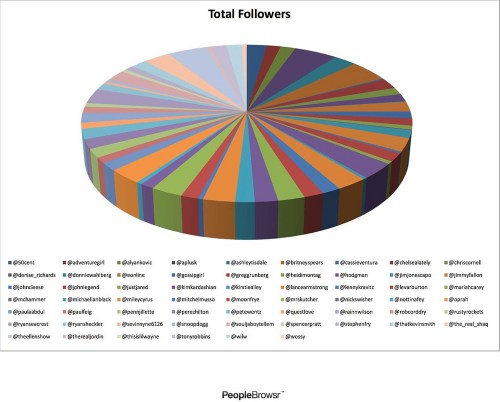
TOTAL FOLLOWERS
In examining the status of celebrities by followers, it comes with no surprise that Mr. Ashton Kutcher ranks at the very top. In many ways, Ashton is responsible for raising the global awareness and adoption of Twitter, as well as  inspiring other celebrities to embrace the vibrant network. Ashton, along with the now legendary race to 1 million followers, has finally tipped the attraction of Twitter beyond the older demographics that originally defined its importance. Teenagers are now flocking to Twitter in the hopes of not only connecting with their heroes, but also experimenting with prospects of flirting with and possibly earning a taste of micro celebrity themselves. I will publish a separate post on this subject shortly?
The top three spots cumulatively represent over 10 million followers, with each earning over 3 million followers each. Ashton, as mentioned above  is number one with almost 3.8 million followers in August. Ellen DeGeneres is in hot pursuit with 3.5 million. And Britney Spears, who was among the original contestants in the race to 1 million, followed closely behind Ellen with 3.48 million followers.
The separation between the top three and those residing in the next several spots was at least one million followers. In fact, in August, the ?2 million follower club? only housed nine members (in order of followers), Kim Kardashian, Ryan Seacrest, Shaq, Oprah Winfrey, Demi Moore, Miley Cryus (who?s currently MIA from Twitter), Jimmy Fallon, Lance Armstrong, and Ashley Tisdale. An interesting observation is that the average number of followers for this current grouping of celebrities totals over 1 million at 1,304,518 exactly.
1. @aplusk ? 3,778,464
2. @theellenshow ? 3,496,041
3. @britneyspears ? 3,480,582
4. @kimkardashian ? 2,514,112
5. @ryanseacrest ? 2,433,803
6. @the_real_shaq ? 2,376,782
7. @oprah ? 2,333,711
8. @mrskutcher ? 2,146,519
9. @mileycyrus ? 2,115,282
10. @jimmyfallon ? 2,099,368
11. @lancearmstrong ? 2,077,717
12. @ashleytisdale ? 2,031,465
13. @mariahcarey ? 1,783,439
14. @50cent ? 1,762,874
15. @souljaboytellem ? 1,668,493
16. @eonline ? 1,625,453
17. @chelsealately ? 1,620,765
18. @petewentz ? 1,591,856
19. @mchammer ? 1,540,286
20. @perezhilton ? 1,524,611
21. @rainnwilson ? 1,504,961
22. @tonyrobbins ? 1,428,620
23. @thatkevinsmith ? 1,390,081
24. @wilw ? 1,367,757
25. @pennjillette ? 1,355,782
26. @johnlegend ? 1,333,071
27. @levarburton ? 1,322,238
28. @alyankovic ? 1,320,214
29. @michaelianblack ? 1,286,746
30. @paulaabdul ? 1,267,045
31. @lennykravitz ? 1,262,223
32. @adventuregirl ? 1,232,757
33. @jimjonescapo ? 1,215,956
34. @denise_richards ? 1,209,800
35. @moonfrye ? 1,183,672
36. @greggrunberg ? 1,157,317
37. @chriscornell ? 1,149,016
38. @gossipgirl ? 1,106,032
39. @ryansheckler ? 1,095,415
40. @robcorddry ? 1,094,003
41. @questlove ? 979,500
42. @nickswisher ? 929,752
43. @paulfeig ? 903,726
44. @stephenfry ? 795,684
45. @heidimontag ? 632,138
46. @rustyrockets ? 584,832
47. @snoopdogg ? 479,882
48. @spencerpratt ? 469,747
49. @wossy ? 422,144
50. @justjared ? 410,589
51. @nottinafey ? 390,926
52. @sevinnyne6126 ? 359,428
53. @therealjordin ? 356,638
54. @mitchelmusso ? 324,008
55. @kirstiealley ? 287,064
56. @johncleese ? 252,519
57. @cassieventura ? 214,717
58. @donniewahlberg ? 96,616
59. @hodgman ? 94,233
60. @thisislilwayne ? 2,610
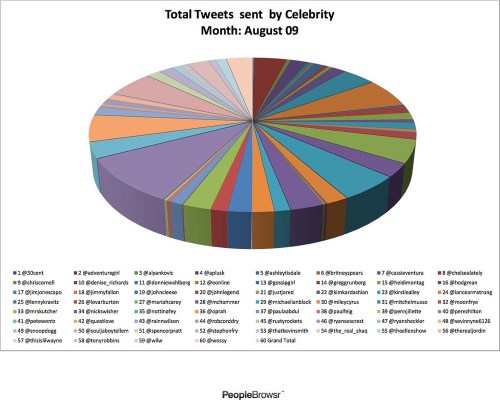
TOTAL TWEETS
When compared to followers, total tweets painted a very different picture. Of course celebrities are ?in-demand,? often too busy to tweet regularly. In August, the top two spots for total tweets are actually not actually published by celebrities per se, but by the personalities and vehicles that document the industry and the activities of the celebrities on and off this list. The ?queen? of media, Perez Hilton took the top spot with almost 1,500 tweets followed by E! Online with 946. Averaging the number of tweets across the board, we see that our celebrities aren?t too quiet, but not overly communicative either, coming in at just under 9 tweets per day or 255 for the month.
1. @perezhilton ? 1,488
2. @eonline ? 946
3. @questlove ? 865
4. @souljaboytellem ? 850
5. @kirstiealley ? 819
6. @justjared ? 735
7. @donniewahlberg ? 608
8. @adventuregirl ? 597
9. @petewentz ? 506
10. @wossy ? 474
11. @mchammer ? 443
12. @kimkardashian ? 432
13. @therealjordin ? 396
14. @mrskutcher ? 366
15. @aplusk ? 309
16. @mitchelmusso ? 308
17. @lancearmstrong ? 289
18. @mileycyrus ? 287
19. @rainnwilson ? 264
20. @stephenfry ? 263
21. @denise_richards ? 259
22. @spencerpratt ? 248
23. @heidimontag ? 230
24. @jimjonescapo ? 229
25. @moonfrye ? 213
26. @greggrunberg ? 211
27. @michaelianblack ? 202
28. @wilw ? 194
29. @johnlegend ? 193
30. @cassieventura ? 190
31. @ryanseacrest ? 180
32. @thatkevinsmith ? 167
33. @sevinnyne6126 ? 162
34. @paulaabdul ? 161
35. @tonyrobbins ? 112
36. @hodgman ? 95
37. @chelsealately ? 83
38. @jimmyfallon ? 83
39. @theellenshow ? 80
40. @ashleytisdale ? 79
41. @chriscornell ? 77
42. @alyankovic ? 71
43. @robcorddry ? 71
44. @paulfeig ? 56
45. @gossipgirl ? 50
46. @the_real_shaq ? 48
47. @rustyrockets ? 45
48. @britneyspears ? 38
49. @snoopdogg ? 38
50. @pennjillette ? 37
51. @johncleese ? 34
52. @levarburton ? 20
53. @50cent ? 17
54. @mariahcarey ? 16
55. @lennykravitz ? 14
56. @nickswisher ? 14
57. @ryansheckler ? 12
58. @thisislilwayne ? 10
59. @oprah ? 3
60. @nottinafey ? 1
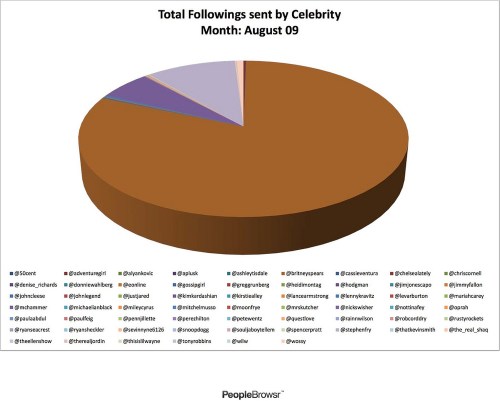
TOTAL FOLLOWING
In Social Media, the act of the ?follow back? is a form of reciprocity and recognition. While it is not a required act, it is dearly appreciated. In August 2009, Britney Spears stood above the rest following over 430,000 people, which is 378,000 more than the second spot, held by Stephen Fry who followed almost 55,000 people and 401,000 more than the number three spot held by MC Hammer with 31,317. The delta between the top three and the rest of the group is significant. The majority follow 500 or less with almost half following fewer than 100. This number surprised me however. Averaging the number of people that each celebrity followed, we uncovered an impressive aggregate of 8,903.
1. @britneyspears ? 432,814
2. @stephenfry ? 54,492
3. @mchammer ? 31,317
4. @wossy ? 3,966
5. @lennykravitz ? 1,863
6. @adventuregirl ? 1,246
7. @questlove ? 1,135
8. @greggrunbeg ? 605
9. @the_real_shaq ? 567
10. @spencerpratt ? 522
11. @perezhilton ? 369
12. @chriscornell ? 309
13. @donniewahlberg ? 289
14. @tonyrobbins ? 279
15. @hodgman ? 276
16. @aplusk ? 231
17. @souljaboytellem ? 229
18. @robcorddry ? 218
19. @heidimontag ? 191
20. @snoopdogg ? 180
21. @therealjordin ? 158
22. @jimjonescapo ? 153
23. @cassieventura ? 145
24. @jimmyfallon ? 142
25. @rainnwilson ? 138
26. @johncleese ? 136
27. @wilw ? 125
28. @ryanseacrest ? 124
29. @alyankovic ? 115
30. @lancearmstrong ? 115
31. @moonfrye ? 112
32. @mrskutcher ? 109
33. @sevinnyne6126 ? 105
34. @levarburton ? 97
35. @petewentz ? 91
36. @johnlegend ? 87
37. @thisislilwayne ? 87
38. @kirstiealley ? 82
39. @michaelianblack ? 81
40. @ashleytisdale ? 76
41. @justjared ? 71
42. @thatkevinsmith ? 69
43. @mileycyrus ? 68
44. @paulfeig ? 67
45. @kimkardashian ? 64
46. @ryansheckler ? 64
47. @nottinafey ? 54
48. @mitchelmusso ? 49
49. @eonline ? 48
50. @denise_richards ? 38
51. @rustyrockets ? 32
52. @paulaabdul ? 29
53. @theellenshow ? 26
54. @mariahcarey ? 23
55. @50cent ? 17
56. @oprah ? 17
57. @chelsealately ? 16
58. @gossipgirl ? 11
59. @nickswisher ? 6
60. @pennjillette ? 5
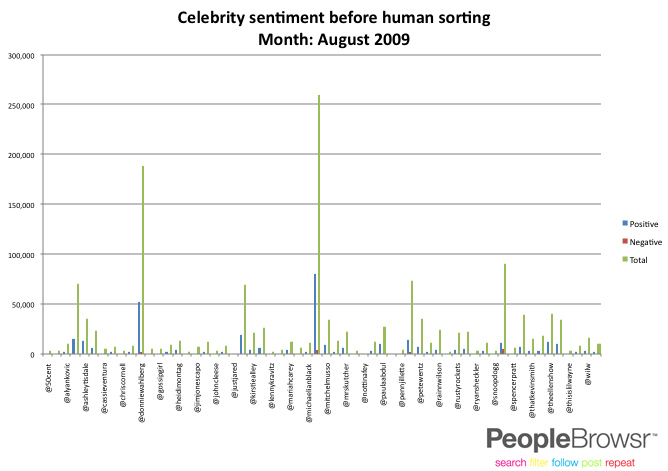
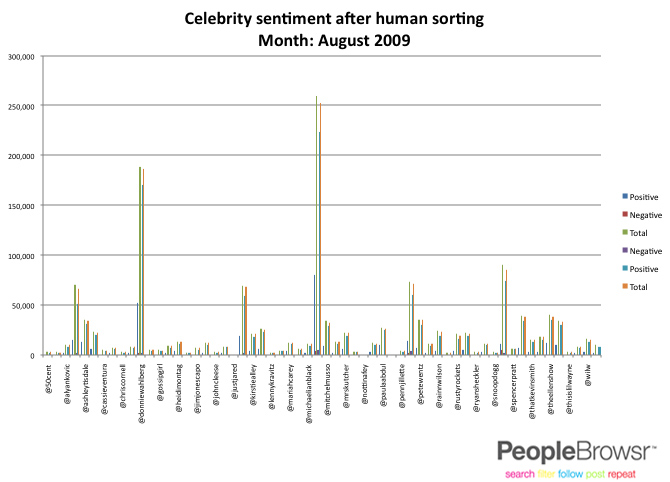
SENTIMENT BEFORE AND AFTER HUMAN SORTING
Similar to the Airline Industry report we published recently, it?s important to note that sentiment, as documented and categorized solely by software algorithms, often misleads the reader. When we apply a human filter to each instance, the results can be profoundly different and is often the case between a truly positive and negative state. In conversations regarding personalities, we observed a profound concentration of positive tweets after human sorting, which is truly distinctive to the celebrity segment and significantly higher than any other industry we?re tracking.
A personal brand, over a product for example, is naturally tied to the psychology of human interaction. When you tweet @ someone, you are, of course, recognizing or hoping to earn the attention of the person directly. In most cases, we?re observing that the positive recognition is linked to the prospect of reciprocity or support.
The sentiment captured and organized using a machine dictionary proves highly inaccurate. The unique machine and human-powered system we?ve built at PeopleBrowsr proves that in the business of perception management and influence, analyzing inaccurate data can prove ineffective, insular, and often futile. Manually analyzing activity provides us with a human perspective as well as empathy.
@50cent
Before Human Sorting Positive: 14% Negative: 2%
After Human Sorting Positive: 82% Negative: 5%
@adventuregirl
Before Human Sorting Positive: 22% Negative: 0%
After Human Sorting Positive: 73% Negative: 0
@alyankovic
Before Human Sorting Positive: 20% Negative: 1%
After Human Sorting Positive: 78% Negative: 4%
@aplusk
Before Human Sorting Positive: 21% Negative: 1%
After Human Sorting Positive: 78% Negative: 2%
@ashleytisdale
Before Human Sorting Positive: 36% Negative: 0%
After Human Sorting Positive: 91% Negative: 1%
@britneyspears
Before Human Sorting Positive: 26% Negative: 1%
After Human Sorting Positive: 89% Negative: 1%
@cassieventura
Before Human Sorting Positive: 19% Negative: 0%
After Human Sorting Positive: 90% Negative: 2%
@chelsealately
Before Human Sorting Positive: 22% Negative: 4%
After Human Sorting Positive: 88% Negative: 1%
@chriscornell
Before Human Sorting Positive: 22% Negative: 5%
After Human Sorting Positive: 84% Negative: 3%
@denise_richards
Before Human Sorting Positive: 25% Negative: 0%
After Human Sorting Positive: 79% Negative: 1%
@donniewahlberg
Before Human Sorting Positive: 28% Negative: 1%
After Human Sorting Positive: 92% Negative: 1%
@eonline
Before Human Sorting Positive: 14% Negative: 3%
After Human Sorting Positive: 87% Negative: 3%
@gossipgirl
Before Human Sorting Positive: 11% Negative: 0%
After Human Sorting Positive: 93% Negative: 0%
@greggrunberg
Before Human Sorting Positive: 17% Negative: 2%
After Human Sorting Positive: 80% Negative: 1%
@heidimontag
Before Human Sorting Positive: 27% Negative: 3%
After Human Sorting Positive: 85% Negative: 7%
@hodgman
Before Human Sorting Positive: 19% Negative: 0%
After Human Sorting Positive: 83% Negative: 3%
@jimjonescapo
Before Human Sorting Positive: 14% Negative: 4%
After Human Sorting Positive: 81% Negative: 4%
@jimmyfallon
Before Human Sorting Positive: 20% Negative: 1%
After Human Sorting Positive: 87% Negative: 1%
@johncleese
Before Human Sorting Positive: 13% Negative: 5%
After Human Sorting Positive: 89% Negative: 0%
@johnlegend
Before Human Sorting Positive: 23% Negative: 2%
After Human Sorting Positive: 92% Negative: 0%
@justjared
Before Human Sorting Positive: 14% Negative: 0%
After Human Sorting Positive: 67% Negative: 0%
@kimkardashian
Before Human Sorting Positive: 27% Negative: 1%
After Human Sorting Positive: 87% Negative: 2%
@kirstiealley
Before Human Sorting Positive: 21% Negative: 1%
After Human Sorting Positive: 87% Negative: 2%
@lancearmstrong
Before Human Sorting Positive: 22% Negative: 1%
After Human Sorting Positive: 91% Negative: 1%
@lennykravitz
Before Human Sorting Positive: 34% Negative: 0%
After Human Sorting Positive: 93% Negative: 0%
@levarburton
Before Human Sorting Positive: 17% Negative: 0%
After Human Sorting Positive: 91% Negative: 0%
@mariahcarey
Before Human Sorting Positive: 32% Negative: 1%
After Human Sorting Positive: 89% Negative: 4%
@mchammer
Before Human Sorting Positive: 20% Negative: 0%
After Human Sorting Positive: 86% Negative: 1%
@michaelianblack
Before Human Sorting Positive: 14% Negative: 3%
After Human Sorting Positive: 88% Negative: 3%
@mileycyrus
Before Human Sorting Positive: 31% Negative: 1%
After Human Sorting Positive: 89% Negative: 2%
@mitchelmusso
Before Human Sorting Positive: 27% Negative: 0%
After Human Sorting Positive: 90% Negative: 1%
@moonfrye
Before Human Sorting Positive: 18%
Negative: 2% After Human Sorting Positive: 85% Negative: 2%
@mrskutcher
Before Human Sorting Positive: 26% Negative: 1%
After Human Sorting Positive: 90% Negative: 2%
@nickswisher
Before Human Sorting Positive: 32% Negative: 5%
After Human Sorting Positive: 95% Negative: 0%
@nottinafey
Before Human Sorting Positive: 0% Negative: 0%
After Human Sorting Positive: 50% Negative: 25%
@oprah
Before Human Sorting Positive: 21% Negative: 1%
After Human Sorting Positive: 88% Negative: 4%
@paulaabdul
Before Human Sorting Positive: 39% Negative: 1%
After Human Sorting Positive: 93% Negative: 2%
@paulfeig
Before Human Sorting Positive: 20% Negative: 0%
After Human Sorting Positive: 95% Negative: 0%
@pennjillette
Before Human Sorting Positive: 14% Negative: 0%
After Human Sorting Positive: 94% Negative: 0%
@perezhilton
Before Human Sorting Positive: 19% Negative: 3%
After Human Sorting Positive: 84% Negative: 6%
@petewentz
Before Human Sorting Positive: 20% Negative: 2%
After Human Sorting Positive: 85% Negative: 2%
@questlove
Before Human Sorting Positive: 16% Negative: 3%
After Human Sorting Positive: 89% Negative: 1%
@rainnwilson
Before Human Sorting Positive: 17% Negative: 2%
After Human Sorting Positive: 84% Negative: 2%
@robcorddry
Before Human Sorting Positive: 18% Negative: 0%
After Human Sorting Positive: 95% Negative: 0%
@rustyrockets
Before Human Sorting Positive: 19% Negative: 1%
After Human Sorting Positive: 87% Negative: 1%
@ryanseacrest
Before Human Sorting Positive: 24% Negative: 1%
After Human Sorting Positive: 89% Negative: 2%
@ryansheckler
Before Human Sorting Positive: 20% Negative: 0%
After Human Sorting Positive: 87% Negative: 3%
@sevinnyne6126
Before Human Sorting Positive: 28% Negative: 1%
After Human Sorting Positive: 90% Negative: 1%
@snoopdogg
Before Human Sorting Positive: 28% Negative: 0 %
After Human Sorting Positive: 85% Negative: 0%
@souljaboytellem
Before Human Sorting Positive: 13% Negative: 5%
After Human Sorting Positive: 87% Negative: 2%
@spencerpratt
Before Human Sorting Positive: 18% Negative: 2%
After Human Sorting Positive: 90% Negative: 5%
@stephenfry
Before Human Sorting Positive: 18% Negative: 1%
After Human Sorting Positive: 89% Negative: 2%
@thatkevinsmith
Before Human Sorting Positive: 18% Negative: 2%
After Human Sorting Positive: 88% Negative: 2%
@the_real_shaq
Before Human Sorting Positive: 17% Negative: 2%
After Human Sorting Positive: 86% Negative: 2%
@theellenshow
Before Human Sorting Positive: 31% Negative: 0%
After Human Sorting Positive: 90% Negative: 1%
@therealjordin
Before Human Sorting Positive: 30% Negative: 1%
After Human Sorting Positive: 92% Negative: 1%
@thisislilwayne
Before Human Sorting Positive: 20% Negative: 5%
After Human Sorting Positive: 89% Negative: 5%
@tonyrobbins
Before Human Sorting Positive: 23% Negative: 2%
After Human Sorting Positive: 88% Negative: 1%
@wilw
Before Human Sorting Positive: 17% Negative: 2%
After Human Sorting Positive: 84% Negative: 3%
@wossy
Before Human Sorting Positive: 21% Negative: 1%
After Human Sorting Positive: 89% Negative: 3%
?
Connect with Brian Solis on:

 TwitterFriendFeedLinkedInTumblrPlaxoPlurkIdenti.caPosterous, orFacebook
?

4021389232_5739e7491e_o4020629887_d8bf7d85ba_o

10 Ways to Get Fired For Building Your Personal Brand

Picture_1


Personal branding is a wave that has been growing ever since kids got cell phones, digital cameras and an email account. Recently it has been taken to an entirely new level. Dan Schawbel is a thought leader who writes extensively about building your personal brand. I too have shared my own comments on this important and power methodology as it relates to marketing in general and more specifically to the entertainment industry.

Before you move into building your own brand… you may want to read Dan’s recent post.
Good insight.
Best,
John

Avatar_2008_copy


10 Ways to Get Fired For Building Your Personal Brand

For all of you employed readers, this post is directed at you because I wouldn’t want you to become unemployed, as you build your own personal brand. Branding has become very personal these days and the relationship we have with our companies is changing very fast, so I think it’s important to focus on what you shouldn’t do at work, not just branding and career strategies.  I view web 2.0 technologies at the driving force that converges our professional and social lives.  Who you are and how you behave outside of work can impact how you’re perceived inside of work and visa versa.  The way the world works now is that you have to spend more time thinking about your actions than you did ten years ago because words spread faster and they are accessible by everyone.

Fired


10 Ways to Get Fired For Building Your Personal Brand

1. Friending your manager on Facebook and then complaining about your job.

At work, people are trying to connect with colleagues on social networks, it’s a fact and part of human nature.  Sometimes, you feel that you’re friends with your co-workers and other times you may think that if you friend your boss or an executive, it may pose for a future career opportunity.  By using social networks strictly for professional use, then this is a good move, but the second (and I mean the second) you want to make it a social endeavor, that’s when the game changes.
A recent survey by OfficeTeam indicated that 32% of executives are not comfortable at all being friended by their boss, 33% weren’t comfortable being friended by people they manage or clients.  You want to get to know a person at work before you friend them or even ask them before you do, otherwise the work environment might be awkward for you and it might open you up to a world of misfortune.  Another survey by Proofpoint suggests that you better wise up on social networks, since 8% of people have been layed off in 2009 for bad behavior, which is double from 2008.
Both Adam Ostrow (editor-in-chief of Mashable) and I feel that is one of the funniest social media bloopers around:

Fbfired


2. Putting your personal brand in front of your company’s brand.

This is still one of the hottest and most controversial topics around, so I feel that it deserves more attention.  A lot of people tweet while at work and don’t deny it please.  The only thing is that 80% of people are tweeting about themselves, not about their company’s, a report by two college professors at Rutgers states.  Companyies, by nature, are looking to build their own brand, sometimes through the use of selectively chosen spokespeople who represent the brand and can be quoted within press articles (cited with the brand).  When you’re getting more attention than your company, you know something is wrong.  You’re not getting paid to be the Oprah of a company.  Instead, you’re being compensated based on the value you provide over time.  When you draw attention to your personal brand instead of your company’s, then your coworkers will get jealous, your manager will wonder why you aren’t getting your work done and you’ll eventually get fired.

3. Complaining that your company blocks social networking sites.

Company cultures are always different and have politcies (csome have social media policies for workers too).  Some block social networking sites, while others refrain because they know that people are doing work at home, so their employment contract is different.  Robert Half International found that 54% of companies prohibit use of social networking Web sites during work hours, including popular sites such as Twitter, Facebook and LinkedIn.  Another survey by ScanSafe, indicates that 20% more companies are blocking social networking sites and that 76% currently block them, which is much more than the Robert half survey.  Don’t complain that your company blocks these sites.  If you’re truly obsessed, why not access them from your mobile phone?  Otherwise, get fired and go somewhere else!
Other companies realize the potential in good corporate web-citizens.  For example, eBillme offers training on how to use social networking sites to spread company information.

Kimberleyswann


4. Attracting the wrong attention to your company’s brand because of your own.

Please don’t say that a blog disclaimer is going to disassociate your brand with your company’s because it’s not!  Brand association is powerful and cannot be undone, which means you have to be smart about what kind of attention you want to draw to yourself.  A reporter, journalist, producer or blogger can easily scrape your content and quote it in a story, without your permission.  They can also link you to your company, even if the blog topic isn’t related to your current work position.  If news breaks out because of this visibility, your company can fire you for carelessness and for harming the corporate brand.  Again, our lives are different now, so you better be safe than sorry (and that sounds like something my parents would say).

5. Announcing your new job on Twitter when you’re still employed.

Your colleagues are following you on Twitter, trust me.  If you’re looking for a career move right now or in the future and you want to promote it, wait till after you’ve moved from your company.  Supervisor references are always important because endorsements rule the world, so if you want to burn your previous employer by not being transparent offline, then you’re in trouble.  You can tell your friends and family, but once you announce it to the world, it’s fair game and you’ll be laid off immediately without the chance to ever return to that company.  A lot of people don’t realize that once you establish a reputation and a network at a company, it can be your safety net in the future if you desperately need a job.

6. Thinking you’re superior to older workers because you’re tech literate.

If you’re a millennial than you have to start figuring out how you want to position yourself at work.  Don’t think for a minute that everyone that’s older than you doesn’t understand technology.  There’s five generations in the workforce, and although millennials will be the majority in the year 2020 (HBS), older workers still have senior positions.  Instead of trying to be superior than them, which can get you fired or put you in a corner, try and be helpful by supporting their projects with your tech expertise.

Five-gens-cs


7. Wearing rags to work because it’s part of your brand.

I’m exaggerating by saying “rags,” but the point is that dressing well will help you get promoted and wearing something inappropriate for work, can get you fired over time, if you refuse to change.  A survey by Harris Interactive and Gillette reveals that 84% of HR professionals agree that well-groomed employees climb the corporate ladder faster than those who aren’t.  They put more emphasis on attire than a handshake!  Now, I know what you’re going to say, “but Dan, what if a mohawk or face Tattoo is part of my brand”?  How are you going to get a job or be taken seriously that way though?  There are common social norms that are accepted in the workplace and how you dress and act is how you’ll be judged by everyone around you.  If you want to be so far outside of the norm, then don’t get a corporate job in the first place!

8. Posting inappropriate photos on Facebook, forgetting that your profile is public.

Ray Lam, a former NDP candidate for Vancouver-False Creek  was forced to resign from his job when photographs were discovered on Faceobook.  One picture showed him palming a woman’s breast and another with his pants down and two people pulling at his underwear.  I was going to post the photo here, but it’s too inappropriate for this blog (see for yourself).  There are other examples of this happening, such as a teacher being fired for her MySpace picture and a nursing home assistent taking pictures with her patients.  I have knews for you:  you don’t own your profiles on social networks.  That’s right, Facebook owns your profile and companies can pay Facebook for that information.  Always think of your profile as public!

9. Spending more time on yourself than being productive during work hours.

A company’s main reason for not allowing social networks at work (aside from legal ramifications for financial institutions, etc) is they feel a productivity loss.  If you’re sharing advice on your social networks at work and blogging, then where is the real business value, unless you’re in a social media specialist type role.  Companies are looking for you to bring in revenue, decrease costs or at least bring in some ROI for the expense they’re paying for you to work there.  If you can’t do that because you’re building your brand at work, then get ready for a big fat pink slip because you’re easily replaceable, now that there’s 6.3 job seekers for every job.

10. Calling in sick, when you’re not, so that you can focus on your brand.

32% of workers have called in sick when they were well at least once this year and 28% of employers think more employees are absent with fake excuses because of the economy, reports Careerbuilder.com.  I know you love your blog and you want to get your name out there, but dishonesty will come back to haunt you.  If you aren’t sick, then show up to work please.  You can always work on building your brand when you get home from work.  Also, when you do excellent work during regular hours, that can do wonders for your brand.

Is Lifetime Networks ahead of their time… or just doing the right thing?

If new technology, a connected community, being authentic, with a pay-it-forward mindset and messaging integration is our future… than Lifetime Networks is ahead of their time.  

All the buzz phrases of the new era seems to be pushing some out of the doldrums of the recession. As if to simply empower one another into “good-will” and helping your fellow man (or woman) is all we need – and maybe it is. From individual, to corporation, from governments to NGO’s, from content developers to advertisers, it does seem people may get that we are all in “this” together. Whatever “this” is. 

Not really a new idea is it? Remember the Christmas movie, “Miracle on 34th Street” where the real Santa sends customers to Macy’s competitor department store? And ultimately, Macy’s realizes the spirit of doing good, being good and helping others can really pay off financially and morally. What is different this time around is the amazing reach and frequency of the message in today’s media driven market. 

Either way… Lifetime has a very integrated campaign on Breast Cancer and (no matter how cynical we have all become), that is good.
John

Lifetime Integrates Breast Cancer Themes in Shows

‘Stop Breast Cancer For Life’ Campaign Branches Out in 15th Year

by MCN Staff — Multichannel News, 10/5/2009 11:36:39 AM

Lifetime Networks is using breast cancer-themed storyline integration as well as public service announcements, partnerships with non-profit agencies and wide-ranging digital efforts in its “Stop Breast Cancer For Life” campaign this year.

For the 15th year of Lifetime’s multiplatform public service campaign, Lifetime is integrating breast cancer themed storylines and important information into Lifetime’s original series, including comedic drama Drop Dead Diva, comedy Rita Rocks, sitcom Sherri and the unscripted health/fitness program DietTribe.

158143-hallie_natalie_dreyfuss

Hallie (Natalie Dreyfuss) of Rita Rocks wins a pink Vespa from Avon Walk.

There will be PSAs featuring Lifetime talent, extensive content from Lifetime Digital and ongoing support ofLifetime’s Stop Breast Cancer for Life online petition to end “drive-through mastectomies.” Four new Lifetime’s Remarkable Women vignettes will feature breast-cancer heroes and advocates. And there will be premieres of films from the Love/Avon Army of Women student filmmaker competition.

“The Power of 15” campaign will promote 15 important tips for breast cancer risk reduction with 15 major breast cancer non-profit organizations and alliances.

Lifetime’s distribution partners will extend the campaign and its messages in communities across the country. Lifetime is working with local distribution partners in more than 120 markets to help build breast cancer awareness through a specialized Stop Breast Cancer for Life affiliate outreach campaign. The campaign is designed to be used by each MSO’s local ad sales, marketing and public affairs groups to educate their subscribers on breast cancer wellness and prevention.

Through this partnership, Lifetime has distributed customizable PSAs along with more than 1,000 point-of-purchase displays, 130,000 Power of 15 magnets outlining the 15 risk reduction and screening tips and 130,000 Lifetime branded pink ribbons to wear in support of the cause.

Viewers will see breast cancer-themed storylines on Sherri (Oct. 6 at 7 p.m. ET/PT), in which a co-worker of Sherri’s (Sherri Shepherd) engages the office to support her efforts in a breast cancer walk; and Drop Dead Diva (Oct. 11 at 9 p.m. ET/PT), when Jane (Brooke Elliott) manages a case that involves a breast cancer survivor who is dropped from a modeling contract because of her “fake” breasts. 

In Rita Rocks (Oct. 27 at 10:30 p.m. ET/PT), Hallie (Natalie Dreyfuss) participates in the Avon Walk for Breast Cancer and wins a pink Vespa (pictured.)

On DietTribe on Oct. 2 , fitness/health expert Jessie Pavelka discussed the importance of staying healthy to prevent breast cancer.

158149-magnet_with_15_tips

Magnet With 15 Tips

Seven new and exclusive PSAs featuring Heidi Klum (Project Runway), Sherri Shepherd andRita Rocks star Nicole Sullivan, offer ways to support the fight against the disease.

Four finalist PSAs from the Love/Avon Army of Women student filmmaking competition at the USC School of Cinematic Arts and New York University’s Maurice Kanbar Institute of Film and Television will air on Lifetime.

Sponsored by Bayer, the four newLifetime’s Remarkable Womenvignettes profile U.S. Rep. Debbie Wasserman Schultz (D.-Fla.), a cancer survivor who introduced legislation to develop a national breast cancer education campaign; Dr. Funmi Opolade, professor of medicine and Human Genetics Director, Cancer Risk Clinic, University of Chicago Medical Center, who has dedicated her research to addressing the needs of African-American breast cancer patients; Alice Crisci, Founder of My Vision Foundation and a cancer survivor whose organization educates breast cancer patients about their fertility options; and Molly Elizabeth and Geri Ximenez, sisters and survivors who are dedicated to spreading prevention tips throughout the Latina community.

Vespa USA is donating a special-edition pink LX 50 scooter to each 15 national partner organizations to use in their fundraising efforts. They are: the American Cancer Society, Breast Cancer Action, Breastcancer.org, Breast Cancer Network of Strength, the Breast Cancer Research Foundation, Bright Pink, Cup With Love, Love/Avon Army of Women (part of the Dr. Susan Love Research Foundation), Susan G. Komen Race for the Cure, My Vision Foundation, Nueva Vida, Prevent Cancer Foundation, SHARE, Sisters Network Inc. and Young Survival Coalition.

The campaign includes extensive content on Lifetime Digital, which has played a major role in the rapid collection of more than 24 million signatures on Lifetime’s Stop Breast Cancer for Life online petition urging Congress to pass the bipartisan Breast Cancer Patient Protection Act. If passed, the legislation will end “drive-through mastectomies,” the practice of when women are sometimes forced to leave the hospital just hours after invasive breast surgery.

A wide-range of breast cancer resource materials available on myLifetime.com, including streamed Lifetime original movies Matters of Life & Dating and the Emmy-nominated Why I Wore Lipstick to My Mastectomy, which is based on the real-life experience of Lifetime public affairs executive Geralyn Lucas.

The movies will also be available through Lifetime on Demand.

Lifetime Digital’s online parenting community MothersClick.com will provide an outlet for women to voice their opinions and concerns surrounding breast cancer and a safe environment for those afflicted with cancer to share their feelings with others who have had similar experiences. 

LifetimeMoms.com will also be highlighting the topic of breast cancer awareness throughout the month.

Lifetime Networks includes Lifetime Television, Lifetime Movie Network and Lifetime Real Women. It’s part of A&E Television Networks, a joint venture of the Disney-ABC Television Group, Hearst and NBC Universal.

REUTERS: New media upends TV ratings. JA: Will consumers decide what advertising they want to view & how they want to view it?

Today, Reuters has an article pointing to another nail in the coffin of the way things use to be, just aren’t going to be the way they will be in the future. Tell me something I didn’t know, right?

Well, this is critically important in the media world especially TV, VOD, Internet and I would add Mobile, Kiosks, TankTop and others. The long and short of it… new media is in – and – old media is… well TBD.

13 channels of TV 40 years ago has turned into so many media platforms you can’t even count!  Advertising to me when I was a kid, meant you ran a kid’s cereal commercial during “Saturday Morning Cartoons” and you pretty much covered MOST of the demo. Today, with audiences so fragmented, where are advertisers/brands suppose to put their dollars to reach a targeted demo?

Content providers and the platforms on which they share their content is moving and shifting so fast and so much, that most involved are scared… maybe with the exception of some new media creators and platform developers.  Why, because there is more opportunity to get an idea out to the masses. With that comes a lot of competition… but it is changing media dramatically!

Proper monetizing of new media is the challenge and the amount of data available to rate content is staggering. Enter… drum roll please…. Coalition for Innovative Media Measurement (CIMM), whose goal is to improve audience metrics.

Who, where, why, when of audience behavior is everything. Heck, going back to the younger demographic… a kids Nintendo DS handheld runs about $130 bucks… and the games are $35 each. Parent’s may buy an iPhone $99 and download free games… cereal ads on iPhones? Maybe. My point is, as buying behavior changes… ads will find each of us.

With 2 and 3 way social media abilities and behavior growing… ultimately what we may see is the consumer (you and I), will decide what advertising we want to view, when, where and how we want to view it. Hang on everyone, it is going to be a bumpy, but fun ride.

Don’t miss next week’s entertainment social media tweetchat –   #entsm  @johnayers  Tuesdays 8PM  PDT.
Best,
John

New media upends TV ratings system

Thu Oct 1, 2009 8:41am EDT

Email | Print | 

Share

 | Reprints | Single Page

R

1 of 1

Full Size

By Basil Katz

NEW YORK (Reuters) – The explosion of ways people watch television is confounding the media industry, which has relied for decades on the Nielsen ratings but now must adapt to the realities of the Internet and on-demand video.

Americans are watching more TV than ever — an average of 151 hours a month — on more networks and in increasingly diverse ways. Industry heavyweights and analysts are calling for a new ratings system to keep up.

At first there was a “crisis in measurement” due to the scarcity of data, said Alan Wurtzel, president of research and media development at NBC Universal, which is 80-percent owned by General Electric Co.

But now, he said, content providers are “drowning in data.”

Broadcasters, content providers and advertisers including consumer products giants Unilever and Procter & Gamble Co are all trying to adapt.

“In the past one-and-a-half years there has been a geometric increase in consumers’ access to the Internet for video, and the metrics market has not kept up,” Wurtzel said.

Though little more than 2 percent of television viewing is done on the Internet, Hulu.com, which combines video from 150 broadcasters on a single platform, has seen its audience grow fourfold in the last year, according to The Conference Board/TNS. Hulu is a joint venture owned by media giants NBC, News Corp and The Walt Disney Co.

COALITION TO SEEK BETTER METRICS

This month 15 of the biggest broadcast network companies, advertisers and media-buying agencies formed the Coalition for Innovative Media Measurement (CIMM) to help improve audience metrics.

CIMM is a LLC composed of 15 voting members, from Unilever and Procter & Gamble to MTV Networks and the Omnicom Group Inc.

Each has contributed $100,000 for a minimum two-year engagement.

CIMM is expected to seek two bids from ratings and data companies: one to conduct set-top box research, the other for cross-platform viewing.

Thanks in part to the conversion to digital cable, many Americans are accessing their favorite shows through set-top boxes provided by cable or satellite companies.

This has led to an explosion of new audience data from half a dozen companies that mine set-top boxes for viewer habits.

Factor in TiVo and video-on-demand systems with upcoming Internet video portals OnDemand Online by Comcast Corp or Time Warner Inc’s TV Everywhere — and getting uniform data becomes that much more difficult.

“With more than 500 channels, and linear and nonlinear viewership, we’re far from the three networks that captivated 90 percent of the viewership 30 years ago,” said Alan Gould, a media analyst at Natixis Bleichroeder.

NIELSEN SAYS UP TO DATE

But Nielsen ratings still hold sway over the buying and selling of advertising.

Major broadcast networks spend roughly $1 billion dollars every year to get ratings from Nielsen, estimates Larry Gold, who publishes Inside Research, a newsletter on the market research industry.

“It has control of the marketplace,” he said.

This is an often-heard gripe against Nielsen, which says it has made significant investments in acquisitions, infrastructure, and research that address the new ways people use media.

As for CIMM, Susan Whiting, chairwoman of Nielsen Media Research, said, “We share all of the objectives of the leaders of the coalition, and we are interested in hearing more about their plans.”

But for Tracey Scheppach, a senior vice president at SMG Exchange, an offshoot of CIMM member Starcom MediaVest, part of France’s Publicis Groupe, Nielsen is partly to blame for the metrics lag.

“While audiences have fragmented, Nielsen’s panel size has not kept up,” said Scheppach. That has led to “dumbed down, inaccurate data,” she said.

For instance, broad audience categories such as women between the ages of 18-49 are hard to translate into targeted advertising.

“There’s bound to be a difference between an 18-year-old woman in Manhattan and a 49-year-old woman in some rural area,” says Alan Gould. “There has been no matching of consumer behavior with the ads.”

(Editing by Daniel Trotta and Xavier Briand)

? Thomson Reuters 2009 All rights reserved

Entertainment’s Economic Future. Credit rating of TV industry goes from “NEGATIVE” to “STABLE”.

The recessions of the past, tended to leave the entertainment industry alone. In fact, it was often that entertainment was robust during the emotional down-turn of the market. People need an uplift… they seek cheap entertainment. TV, DVD, Movie… but not this time… It seems that the entertainment sector has felt it a bit this time around.  This article is the first I have seen that talks about the “potential” swing back.

What do you see? Are good times coming back? Do you fear the long-term for the TV industry? Love to know what you think? 
Home | TV/Cable News | Moody?s gives the entire TV industry an upgrade

Moody?s gives the entire TV industry an upgrade

Font size:  

Moody’s Investors Service has changed its Industry Sector Outlook for the US Broadcast TV sector to ?stable? from ?negative.? The credit ratings firm said the new outlook expresses Moody’s expectations for the fundamental credit conditions in the industry over the next 12 to 18 months. 

The outlook change incorporates Moody’s view that broadcast revenue declines will moderate in the second half of 2009 and that growth will resume in 2010, supported by political advertising and a mild recovery in advertising markets. 

Moody?s analysts now say the boost from political advertising should provide local TV broadcasters additional time to realize a return of core advertising demand as their local economies heal. Furthermore, “given the combination of fixed costs inherent in the business plus cost cutting initiatives undertaken during the downturn, the majority of the revenue lift will likely fall through to EBITDA,” said Moody’s analyst Karen Berckmann. The stable outlook indicates that Moody’s does not expect business conditions for the broadcasters to materially improve or worsen. 

Positive indicators, the Moody?s update said, include the improving trend in consumer confidence, which rose to a better than expected 73.5 in September, marking the highest point since January 2008. The increase could portend firmer consumer expenditures, and expectations for higher consumer spending typically lead advertisers to boost their marketing budgets. In Moody’s view, while not growing significantly, advertising budgets are beginning to open up and have ceased declining. 

?Nevertheless, multiple constraints will likely hinder the return of more meaningful near-term growth, and some downside risks remain. Moody’s does not anticipate a return to job creation prior to the second half of 2010. Additionally, TV broadcasters rely heavily on local advertising, which will likely lag national advertising in terms of recovery. Auto advertising, which comprises a significant portion of revenue for most broadcasters, will also remain a pressure point as vehicle sales in 2010 are expected to remain far below historical levels,? Moody?s said.

?Furthermore, the stable outlook does not necessarily presage positive ratings actions; indeed, the potential for further negative actions remains, particularly given lingering liquidity concerns at the lower end of the ratings scale. Covenant challenges will likely continue for many of these issuers, and access to the credit markets remains uncertain,? the ratings agency noted. Some companies have achieved covenant relief, Moody?s said, but added that the amendments might require companies to return to lenders for another round of negotiations. 

RBR-TVBR observation:

 This is what we?ve been hearing from people in the industry for a while now. It is nice to see that analysts looking in from the outside now share that view. 

We?re not yet into the good times. But the bad times appear to be ending.

Font_decreaseFont_enlargeThumbnail